Part 3: Anti-Aircraft Defense: The Physical Mechanisms Behind Spore Deflection
The Hidden Architecture of Cannabis: A 4-Part Series on Phenotype-Dependent Microbial Resistance
By Christopher Leavitt
In the previous two parts, we established that significant differences exist in Total Yeast and Mold outcomes between cultivars grown in identical conditions. We then identified that TYM resistance operates differently from classical pathogen resistance because the TYM test measures environmental contamination broadly, not just active fungal colonization.
We identified three distinct sources of TYM contamination: environmental spore deposition, surface colonization after landing, and endogenous (internal) contamination. Each source implies a different resistance mechanism. We hypothesized three corresponding defense strategies: chemical resistance, ground defense (cuticle and lignin as physical armor), and anti-aircraft defense (preventing deposition altogether).
Part 3 focuses on the most promising and novel of these: anti-aircraft defense — the mechanism by which certain cannabis cultivars may actively repel airborne spores before they ever make contact with the flower surface.
The boundary layer principle in action
Cacti are famous for their spines, which deter predators from reaching the soft tissue beneath. But those spines serve another, equally critical function: they create a boundary layer (a zone of relatively still air surrounding the photosynthetic surface) that traps moisture and modulates the microclimate around the plant.
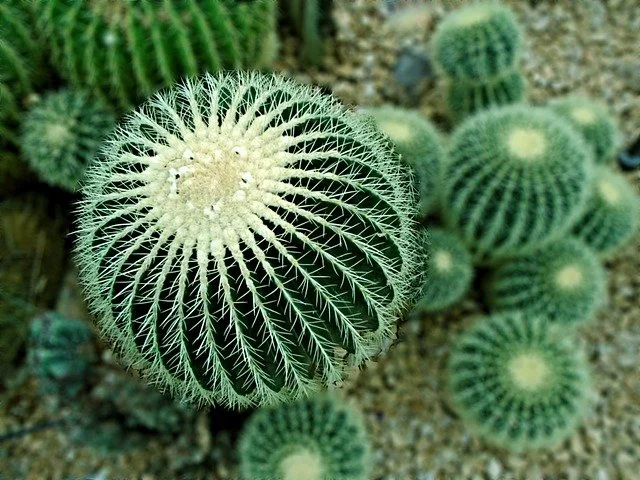
The principle operates through a simple physical mechanism. When you get goosebumps on your arm, the raised hairs trap a layer of warm air against your skin. That stationary air layer insulates you. It's passive boundary layer formation.
But there's a more active version of this principle that's far more relevant to spore deflection, and it's well-established in aeronautical and fluid dynamics engineering.
A surface actively emitting gas creates a positive pressure zone that resists incoming flow. This effect is well-documented in particle deposition studies: surfaces with outward gas flux show measurably reduced particle landing rates compared to passive surfaces. The faster the outward flow, the stronger the deflection effect.
In cannabis, actively transpiring flower surfaces may operate on this same principle.
Here's the mechanism: plants continuously push gas outward through stomatal pores- water vapor and oxygen escaping as the plant photosynthesizes and transpires. That outward gas flux creates a positive pressure gradient at the flower surface. Rather than just passively trapping air, this active outward breathing generates a protective envelope that works against incoming spores attempting to deposit. The plant is literally breathing outward against them. And perhaps the shape, clustering, size, or organization of trichomes impacts the efficiency with which deflection occurs.
Temperature and humidity differences reinforce this effect. The Punja et al. study measured internal inflorescence humidity and temperature and found them consistently higher than ambient conditions and critically, these measurements varied significantly between cultivars. Some plants were creating their own warm, humid internal microclimate independent of room conditions. But what's equally important is the surface-level temperature differential: actively transpiring plants maintain cooler leaf surfaces because convective heat exchange is more efficient when gas is moving outward. That temperature differential itself generates pressure gradients at the microscale.
The result is a cultivar-specific defense system: flowers that transpire actively and maintain lower surface temperatures are actively pushing air and gas outward, creating conditions that reduce spore deposition probability.
The macroscopic principle breeders already know
This isn't a new observation at the macroscopic level. The Punja et al. study confirmed what experienced breeders have long known: cultivars with lower inflorescence leaf counts and more open bud architecture show lower TYM. The same trait: organized, aerodynamic flower structure with adequate internodal spacing, has been a selection criterion in disease-resistant breeding for years precisely because it promotes airflow and reduces moisture accumulation within the bud.
I've been actively selecting for this trait in my own breeding work for years for botrytis and powdery mildew resistance.
What's novel here isn't the macroscopic observation. It's the proposed microscopic mechanism.
What if the reason open architecture reduces TYM isn't just about bulk airflow removing moisture, but about active transpiration creating a pressure differential that actively repels spore deposition before it even occurs? The architectural trait we've selected for disease resistance may have been providing anti-aircraft defense all along, we just didn't have a mechanistic framework to understand why.
The Punja study gives us that framework. Cultivars with lower inflorescence leaf counts showed lower TYM counts. These cultivars have more open bud architecture, less leaf mass physically blocking internal airflow, more opportunity for convective circulation through the flower structure itself. That same architecture promotes higher transpiration rates because more surface area is exposed to air movement. Higher transpiration means cooler surfaces, which means stronger positive pressure gradients, which means greater resistance to spore deposition.
The connection closes: open bud architecture → enhanced transpiration → lower surface temperature → active outward gas pressure → reduced spore deposition → lower TYM.
Trichome architecture as physical exclusion
Beyond the macroscopic flower structure, there's a microscopic layer to this defense: trichome morphology itself.
Cannabis flowers are not smooth surfaces. They are forests of structures at the microscopic scale. Trichomes vary dramatically between cultivars in their density, height, orientation, and surface characteristics. The Punja study used scanning electron microscopy to observe mycelium ramifying across stigmatic tissues and trichomes in high-TYM cultivars showing that the trichome architecture does interact with microbial settlement.
The question is whether trichome characteristics might actively contribute to spore deflection rather than just providing a surface for colonization to occur.
In principle, trichome density and orientation could create aerodynamic effects that deflect particles before they reach the underlying bract surface. A cultivar with trichomes oriented perpendicular to airflow, densely packed, with substantial height, might create turbulence that prevents spores from settling. This isn't analogous to the cactus spine trapping air- it's analogous to how fish gill structures create vortex shedding patterns that deflect particles. The physical architecture itself resists passive settlement.
This remains hypothetical. But it's testable. Detailed microscopy comparing trichome architecture across high-TYM and low-TYM cultivars could reveal whether architectural differences correlate with deposition resistance.
The role of surface charge… a speculative mechanism
There is one additional mechanism worth naming, though the evidence is more speculative: electrostatic charge.
Cannabis flowers carry an electrostatic charge. This is the mechanism by which they attract pollen. It's real, measurable, and varies between cultivars. Airborne spores also carry charge signatures. In principle, variation in how cannabis flowers express surface charge could influence spore deposition rates by either attracting or repelling spores depending on charge polarity and magnitude.
Does a cultivar with lower pollen-attracting charge also repel certain spore types? Does higher charge actively repel them? Does charge magnitude correlate with TYM outcomes?
These remain open questions rather than tested hypotheses. But they're worth flagging as potential contributors to the anti-aircraft system.
How do we test this hypothesis?
The mechanisms described above are grounded in established physics- boundary layers, pressure gradients, and particle deposition dynamics are well-understood in aeronautical and fluid dynamics engineering. The question is whether they actually operate at meaningful scale on cannabis flower surfaces.
Testing this requires measurements we haven't yet collected systematically in cannabis.
Particle deposition studies would measure actual spore landing rates on high-TYM versus low-TYM cultivar surfaces under controlled airflow conditions. This is the most direct test: do low-TYM cultivars genuinely experience lower spore deposition, or is the TYM difference driven entirely by post-contact colonization resistance? The answer fundamentally changes which traits matter for breeding.
Thermal imaging during late flower could map surface temperature variation across different genotypes and relate it to TYM outcomes. If actively transpiring, cool-surface cultivars show lower TYM, that supports the transpiration-pressure mechanism. If surface temperature doesn't correlate with TYM, the hypothesis weakens.
Detailed microscopy of trichome architecture, comparing cultivars with dramatically different TYM outcomes, could reveal whether structural differences correlate with potential aerodynamic effects. Do low-TYM cultivars have different trichome density, orientation, or height compared to high-TYM cultivars? Are those differences architecturally positioned to create deflection?
Stomatal density and distribution mapping specifically on bract tissue (not just fan leaves) could quantify whether cultivars with lower TYM show higher stomatal abundance in reproductive tissues. If they do, it supports the transpiration-based mechanism.
The data already exists in these measurements. We've just never collected it systematically in the context of TYM resistance.
What this means for breeding
If anti-aircraft defense is the primary driver of TYM resistance, then the traits breeders should be selecting for are fundamentally structural: bud architecture, inflorescence leaf density, trichome characteristics, and the ability to maintain active transpiration through late flower. These are not cannabinoid traits, not terpene traits- they are physical traits.
This explains why the Punja study found no correlation between terpene profile, THC content, or CBD content and TYM outcomes. The resistance mechanism isn't chemical. It's architectural and physiological.
For breeders already selecting for open bud architecture and disease resistance, this is encouraging news: you've likely been selecting for anti-aircraft defense without knowing it. The mechanism is deeper than you may have realized, but the phenotype you've been targeting is probably the right one.
For breeders starting from scratch with TYM as a formal selection criterion, the path is clearer: prioritize phenotypes with organized inflorescence architecture, lower inflorescence leaf counts, and the capacity to maintain vigorous transpiration through late flowering. Then validate with the thermal imaging and microscopy tools that will give you real insight into which cultivars are actually generating the pressure differentials that repel spores.
Part 4: Synthesis and the Future of TYM-Resistant Breeding
In the final part of this series, we'll synthesize everything we've learned about anti-aircraft defense, ground defense, and chemical resistance. We'll discuss how these mechanisms interact, how breeders can practically select for TYM resistance without waiting for perfect mechanistic understanding, and how the cultivar data you collect now can feed into a decades-long breeding agenda around TYM as a formal trait.
We'll also address the broader question: if cultivar selection can reduce TYM naturally, what does that mean for facility design, for post-harvest handling, and for the role of remediation in an industry that's becoming increasingly sophisticated about microbial risk?
Christopher Leavitt is the founder of Voyager Genetics, a cannabis genetics IP licensing and consulting company based in Lisbon, Portugal. Voyager supplies GACP-compliant, phenohunted clone genetics to licensed medical cannabis producers across Europe.
Further reading:
Punja, Z.K., Ni, L., Lung, S., and Buirs, L. (2023). Total yeast and mold levels in high THC-containing cannabis (Cannabis sativa L.) inflorescences are influenced by genotype, environment, and pre- and post-harvest handling practices. Frontiers in Microbiology, 14:1192035. https://doi.org/10.3389/fmicb.2023.1192035